If you want to fast-track your way into a technical or scientific career, spending four years (and a small fortune) on a bachelor's degree right out of the gate isn't your only option. For many students looking at the rapidly shifting 2026 job market, an Associate of Science degree is the perfect launchpad.
This two-year program packs a serious punch. It zeroes in on the math, biology, chemistry, and real-world tech skills that today's employers are actively searching for. It's incredibly cost-effective, lets you enter the workforce years earlier, and transfers seamlessly to a four-year university if you decide to upgrade later. Whether you're eyeing healthcare, renewable energy, or computer science, here is what you can expect from a modern A.S. program.
Building a Bulletproof Foundation The core curriculum of an A.S. degree isn't just about passing tests; it’s about learning how to process complex information. While you'll take essential courses in writing and computer literacy, the real heavy lifting happens in the math department.
Forget the abstract math you might have hated in high school. Mandatory classes like Calculus and Statistics are taught with a focus on real-world modeling. Calculus helps you understand dynamic systems (like fluid mechanics or population growth), while statistics gives you the tools to analyze data and separate actual trends from random noise. If you want to survive in modern STEM fields, statistical literacy is entirely non-negotiable.
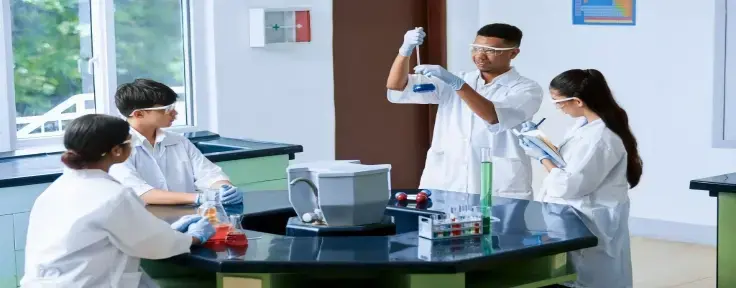
Getting Your Hands Dirty: Science and Lab Work You can't learn science just by reading about it. An A.S. degree dives deep into the core principles of Biology, Chemistry, and Physics. But more importantly, it moves you away from the textbook and into the laboratory.
Modern lab courses are highly hands-on. You aren't just memorizing the periodic table—you’re operating industry-standard equipment, learning strict safety protocols, and conducting actual experiments. This translates to serious research and data analysis skills. By the time you graduate, you’ll know how to design surveys, run experiments, and critically evaluate the findings.
Soft Skills for Hard Sciences There is a massive misconception that STEM professionals just sit alone in a room staring at spreadsheets. The reality is that science is deeply collaborative, and the best ideas die if they aren't communicated well.
A good A.S. program pushes you to write clear, concise lab reports and research papers. You’ll also likely take public speaking or presentation classes. Being able to explain a complex environmental data set to a room full of non-scientists is a superpower in the corporate world. Furthermore, these programs take a highly interdisciplinary approach. You’ll start to see how computer science bleeds into biology (bioinformatics), and how chemistry impacts environmental sustainability.
Solving Problems with 2026 Tech Employers aren't paying you just to know facts; they’re paying you to solve problems. Throughout the degree, you'll be forced to flex your critical thinking muscles. You might analyze climate data to predict environmental impacts or troubleshoot a mechanical engineering flaw.
Because we are officially deep into the 2020s, technology integration is a massive part of this. You won’t just be using basic spreadsheets. Expect to train on modern statistical analysis software, data visualization tools, and contemporary lab management systems. Knowing how to use the tech that powers the industry makes you immediately useful on your first day of work.
Tailoring Your Career Path One of the best parts about an A.S. degree is the flexibility. Through elective courses, you can easily pivot your specialty to match exactly what you want to do. Interested in the intersection of tech and health? Load up on Health Sciences and Data Analytics electives.
Graduates leave these programs incredibly well-prepared for roles in nursing, lab technology, IT, and green energy. Plus, since many programs actively push for internships or co-ops, you can build a solid resume before you even walk across the graduation stage. If you're looking for a practical, highly respected way to jump straight into the workforce—or build a rock-solid foundation for a future bachelor's—an Associate of Science is arguably the smartest investment you can make this year.