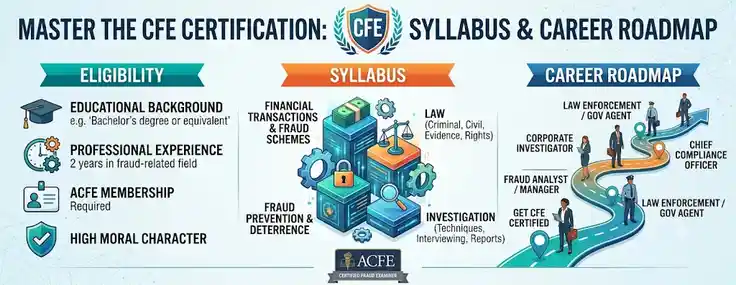
The CFE Certification (Certified Fraud Examiner), awarded by the Association of Certified Fraud Examiners (ACFE), is the global gold standard for anti-fraud professionals. Obtaining the CFE credential validates expertise in fraud prevention, detection, and investigation. Candidates must hold a bachelor’s degree (or equivalent experience), earn 50 points on the ACFE point system, and pass a 4-part exam covering Financial Transactions, Law, Fraud Prevention, and Investigation. Certified Fraud Examiners earn significantly higher salaries and hold key positions in compliance, auditing, and corporate risk management.
What is the CFE Certification?
Financial fraud costs organizations billions of dollars annually, creating high demand for specialists who can detect, investigate, and prevent illicit activities. The CFE Certification establishes professional credibility across corporate, legal, and governmental sectors.
Unlike general accounting credentials, the Certified Fraud Examiner designation focuses specifically on white-collar crime, financial forensics, legal frameworks, and investigative psychology.
CFE Exam Eligibility Requirements
To qualify for the CFE credential, applicants must satisfy specific academic, professional, and ethical requirements established by the ACFE.
The ACFE Point System
Eligibility is calculated using a point system where candidates must accumulate at least 50 points to apply and 40 points to take the exam. Full certification requires the full 50 points plus two years of professional experience.
-
Education: A bachelor's degree automatically awards 40 points. Higher degrees award additional points (Master's = 40 points + credit; Ph.D. or Juris Doctor = full eligibility credit).
-
Professional Experience: Every year of full-time, direct professional experience in a fraud-related field grants 10 points.
Qualifying Professional Fields
To fulfill the two-year professional experience requirement, your work history must fall under one or more of these domains:
-
Accounting and Auditing: Forensic accounting, internal/external auditing, or financial analysis.
-
Criminology and Sociology: White-collar crime research, criminal justice, or fraud deterrence modeling.
-
Fraud Investigation: Corporate internal investigations, law enforcement background, or private intelligence.
-
Loss Prevention & Security: Physical security management, risk mitigation, or asset protection.
-
Legal Frameworks: Prosecution, defense, or legal compliance specializing in fraud cases.
CFE Exam Syllabus and Structure
The exam tests proficiency across four comprehensive core domains. Understanding the CFE exam syllabus and structure is vital for planning an efficient study strategy.
| Exam Section | Key Topics Covered | Question Count & Time |
| Financial Transactions & Fraud Schemes | Asset misappropriation, financial statement fraud, bribery, corruption, money laundering, and accounting concepts. | 100 questions (120 mins) |
| Law | Criminal vs. civil law, evidence rules, rights of the accused, courtroom testimony, and grand jury procedures. | 100 questions (120 mins) |
| Fraud Prevention & Deterrence | Crime causation theories, corporate governance, fraud risk assessment, ACFE Code of Ethics, and internal controls. | 100 questions (120 mins) |
| Investigation | Interviewing techniques, digital forensics, document analysis, tracing illicit assets, and report writing. | 100 questions (120 mins) |
Exam Format
-
Total Questions: 400 multiple-choice questions (100 per section).
-
Delivery: Computer-based exam administered with remote online proctoring or at testing centers via Prometric.
-
Passing Score: Minimum of 75% on each of the four individual sections.
How to Become a Certified Fraud Examiner: Step-by-Step
Navigating the process to become a CFE involves five distinct steps:
-
Join the ACFE: Active membership in the global ACFE Association is mandatory prior to registering for the exam.
-
Submit Your Application: Upload proof of education, professional recommendations, and employment history to verify your 50 points.
-
Prepare Study Materials: Choose between self-study using the official CFE Exam Prep Course or enrolling in structured CFE exam online training.
-
Pass the Four Exam Sections: Schedule and complete all four modules within your designated exam window.
-
Gain Approval & Maintain Certification: Once passed, the ACFE Board of Regents grants your credential. Maintain status by completing 20 hours of Continuing Professional Education (CPE) annually.
Certified Fraud Examiner Salary and Career Outlook
Earning the CFE credential significantly accelerates career progression and boosts compensation potential across multiple industries.
According to the ACFE Compensation Guide for Anti-Fraud Professionals, CFEs earn an average of 31% more than non-certified peers.
Top Job Roles for CFEs
-
Forensic Accountant / Auditor: Performs deep-dive financial audits to uncover accounting anomalies and intentional misstatements.
-
Corporate Investigator: Leads internal inquiries into employee misconduct, bribery, or intellectual property theft.
-
Anti-Money Laundering (AML) Analyst: Monitors banking transactions to ensure regulatory compliance and flag suspicious activity.
-
Chief Compliance Officer (CCO): Oversees corporate governance, ethics policy, and risk management frameworks.
Effective CFE Exam Study Material and Preparation Tips
Selecting the right CFE exam study material makes the difference between passing on the first attempt or facing retakes.
-
Use Practice Question Banks: Focus heavily on practice exams to familiarize yourself with the phraseology and nuance of ACFE questions.
-
Target Weak Domains: Allocate extra time to sections outside your primary work experience (e.g., accountants should focus heavily on Law, while legal professionals focus on Financial Transactions).
-
Structured Training: Candidates seeking an accelerated path often benefit from structured review courses and specialized exam dumps. You can explore structured exam preparation resources at PassYourCert CFE Training.
Immediate Next Steps for Your Anti-Fraud Career
If you meet the eligibility criteria, register as an ACFE member today, calculate your 50-point score, and select a target exam date 60 to 90 days out to maintain consistent study momentum.