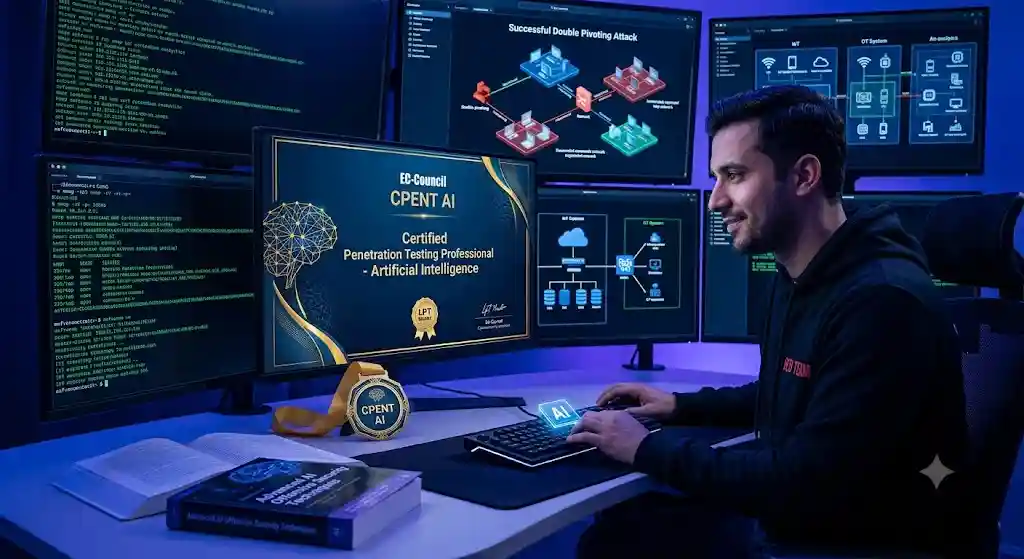
The CPENT AI certification is an elite, practical credential by EC-Council that validates advanced, AI-driven penetration testing skills across complex enterprise environments. Earning this certification requires passing a rigorous, 100% hands-on exam that tests your ability to exploit Active Directory, bypass segmented networks through double pivoting, compromise IoT systems, and leverage artificial intelligence for offensive operations. Candidates who score above 70% achieve the CPENT, while those scoring 90% or higher simultaneously earn the prestigious LPT Master certification.
The landscape of offensive security has shifted. Traditional vulnerability scanning and linear exploitation methodologies are no longer sufficient against modern, segmented networks defended by active, machine-learning-driven threat detection. By integrating artificial intelligence into every phase of a penetration test—from automated reconnaissance to intelligent payload delivery—the EC-Council has created a benchmark for the next generation of Red Team operators.
The EC-Council CPENT AI Syllabus: What Will You Actually Learn?
The updated EC-Council CPENT AI syllabus moves far beyond basic ethical hacking. It forces candidates to operate within live cyber ranges featuring DMZs, VPNs, proxies, and deeply segmented subnets.
The core modules focus on advanced, real-world exploitation:
-
AI in penetration testing certification domains: Utilizing machine learning models for sophisticated OSINT gathering, automated vulnerability fuzzing, and evading smart Web Application Firewalls (WAFs).
-
Double Pivoting and Segmented Networks: Tunnelling traffic through compromised hosts to access deeply hidden network segments that are completely isolated from the internet.
-
Active Directory (AD) Exploitation: Executing horizontal privilege escalation, dumping cached credentials, and forging Kerberos tickets in heavily fortified AD environments.
-
IoT and OT / SCADA Penetration Testing: Moving laterally from traditional IT infrastructure into Operational Technology (OT) and compromising internet-of-things devices using binary analysis.
-
Advanced Binary Exploitation: Writing custom exploit code, reverse engineering binaries, and bypassing modern memory protections like ASLR and DEP.
CPENT AI Prerequisites and Requirements
Unlike entry-level certs, this program demands a robust technical foundation. The CPENT AI prerequisites and requirements unofficially dictate that candidates possess deep networking knowledge, proficiency in Bash and Python scripting, and an understanding of assembly language for debugging (via tools like GDB). While EC-Council highly recommends holding the CEH (Certified Ethical Hacker) or having equivalent working experience (typically 2–3 years in InfoSec), anyone can attempt the exam if they undergo official training through an accredited partner.
CPENT AI Practical Exam Format
The exam is notoriously grueling. The CPENT AI practical exam format is a 24-hour, 100% hands-on challenge hosted on a custom cyber range.
Exam Execution Options:
-
Single 24-Hour Session: Designed for extreme endurance, simulating a high-stakes, time-crunched Red Team engagement.
-
Two 12-Hour Sessions: Allows candidates to split the exam across two days, offering a more methodical approach to enumeration, exploitation, and rest.
To succeed, you must not only capture the flags but also document your attack chains meticulously in a commercial-grade penetration testing report.
CPENT and LPT Master Certification: The Dual-Credential Advantage
One of the most unique aspects of this exam is its tiered scoring system.
-
Score 70% to 89%: You earn the CPENT credential.
-
Score 90% or higher: You are simultaneously awarded the CPENT and LPT Master certification (Licensed Penetration Tester). The LPT Master is widely recognized as one of the most elite, master-level distinctions in the cybersecurity industry.
CPENT vs OSCP: Which Elite Credential Wins?
Professionals constantly debate the value of CPENT vs OSCP (Offensive Security Certified Professional). Both are 24-hour practical exams, but they test fundamentally different scopes and methodologies.
| Feature | CPENT AI | OSCP (PEN-200) |
| Architectural Focus | Multi-disciplinary (IT, OT, IoT, AD), double pivoting, AI integration. | Pure IT infrastructure, Active Directory, manual exploitation, limited pivoting. |
| Exam Format | 24 hours (can split into two 12-hour sessions). | 24 hours (continuous single session). |
| Scoring Tiers | 70% (CPENT) / 90% (LPT Master). | Pass/Fail (70 points required). |
| Reporting | Comprehensive commercial penetration test report required. | Professional report required within 24 hours post-exam. |
| AI Utilization | Heavily integrated into syllabus and methodologies. | Primarily manual; AI tools heavily restricted during the exam. |
If your goal is to understand how to breach isolated OT systems or leverage AI for offensive operations, the CPENT provides a significantly broader, more modernized skill set.
CPENT AI Certification Cost Breakdown
Investing in your career requires understanding the financial commitment. The CPENT AI certification cost varies based on your chosen learning modality:
-
Self-Paced / On-Demand Training: Starts at $1,999 USD, which includes official courseware, 6 months of iLabs access, and the exam voucher.
-
Live Instructor-Led Training: Typically starts at $2,799 USD for interactive, mentored bootcamps.
-
Standalone Exam Voucher: For those who opt to bypass training and challenge the exam directly (requires approval and proof of experience), the voucher alone costs around $950 to $1,200 USD, plus proctoring fees.
When comparing this to the potential salary bump—certified penetration testers routinely command six-figure salaries—the ROI is typically realized within the first month of a new role.
Your CPENT AI Exam Preparation Guide
Success in this exam is dictated by methodology, not luck. Follow this CPENT AI exam preparation guide to ensure you are ready for the cyber range:
-
Master Open Source Intelligence (OSINT) and Dorking: The CPENT is an open-book exam. Your ability to rapidly research unfamiliar protocols, architectures, or exploits during the 24-hour window is critical.
-
Drill Down on Network Pivoting: Practice setting up SSH tunnels, proxychains, and port forwarding. You must be comfortable routing your attack tools (like Nmap or Metasploit) through intermediate, compromised Linux and Windows jump boxes.
-
Familiarize Yourself with AI-Driven Tools: Understand how to script automated reconnaissance workflows using AI APIs or machine learning-enhanced fuzzers to rapidly identify misconfigurations.
-
Hone Your Active Directory Skills: Build a home lab. Practice AS-REP Roasting, Kerberoasting, and abusing misconfigured Domain Controller permissions.
-
Develop a Reporting Template Early: Do not wait until the exam to figure out how to write an executive summary. Create a robust Markdown or Word document template beforehand so you only need to plug in your screenshots and attack narratives during the post-exam reporting phase.
Next Steps for Red Team Dominance
The era of manual, checklist-based penetration testing is dead. Adversaries are weaponizing artificial intelligence, and as an offensive security professional, you must do the same. If you are ready to validate your skills against IoT, OT, segmented networks, and hardened AD environments, it is time to secure your voucher.
Explore our comprehensive resources and book your exam directly through our PassYourCert CPENT AI portal. Equip yourself with the right training, master the cyber ranges, and claim your LPT Master status today.