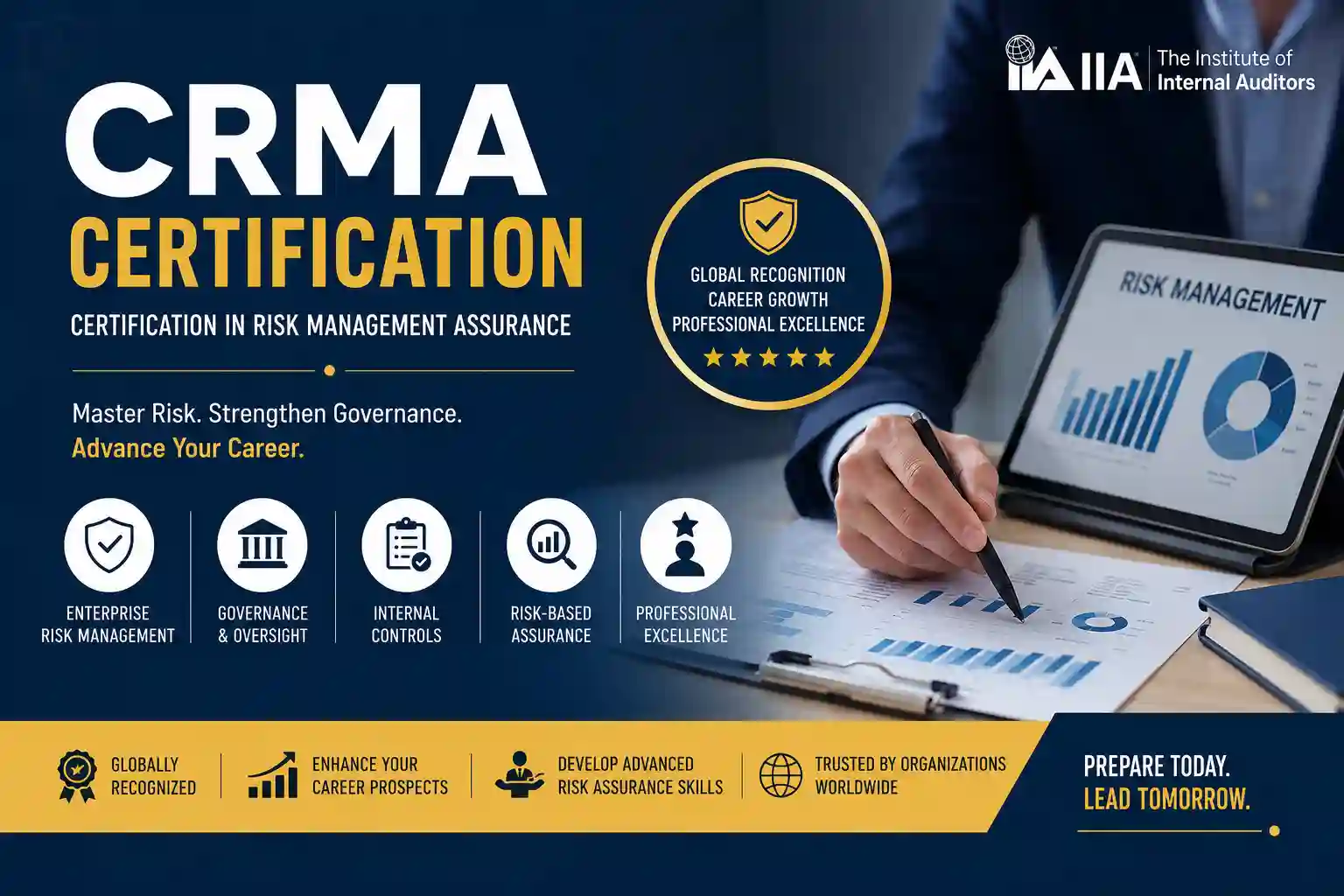
CRMA certification (Certification in Risk Management Assurance) is a globally recognized credential designed for internal auditors and risk professionals who evaluate governance, risk management, and internal controls. Offered by The Institute of Internal Auditors (IIA), it validates advanced expertise in providing assurance on enterprise risk management. Professionals pursuing CRMA gain stronger career opportunities, higher earning potential, and greater credibility in audit and risk roles. Success requires meeting eligibility requirements, understanding the exam format, and following a structured preparation plan.
Risk management has become a board-level priority across every industry. Organizations need professionals who can assess strategic risks, strengthen governance, and provide independent assurance that risk management frameworks actually work. That is exactly where CRMA certification stands out.
Unlike general auditing credentials, the Certification in Risk Management Assurance (CRMA) focuses specifically on evaluating enterprise risk management, governance processes, and organizational resilience. Whether you are an internal auditor, compliance specialist, or risk consultant, CRMA demonstrates that you possess specialized expertise trusted by employers worldwide.
What Is CRMA Certification?
CRMA (Certification in Risk Management Assurance) is a professional certification administered by the Institute of Internal Auditors (IIA). It validates an individual's ability to provide assurance regarding an organization's governance, risk management, and internal control processes.
Rather than managing risks directly, CRMA professionals independently evaluate whether risk management practices are effective, aligned with business objectives, and capable of supporting long-term organizational success.
Professionals holding CRMA often work in:
- Internal Audit
- Enterprise Risk Management (ERM)
- Governance, Risk & Compliance (GRC)
- Financial Services
- Healthcare
- Government Agencies
- Consulting Firms
- Public Accounting
Why CRMA Certification Matters
Organizations today face increasingly complex operational, cybersecurity, regulatory, and financial risks. Executive leadership relies on independent assurance professionals to verify that risk frameworks are functioning effectively.
CRMA helps professionals demonstrate expertise in:
- Enterprise Risk Management
- Governance evaluation
- Internal controls
- Strategic risk assessment
- Risk reporting
- Assurance engagements
- Risk-based auditing
Employers value CRMA because it proves candidates understand how risk management supports organizational performance—not just compliance.
CRMA vs CIA vs CISA
| Feature | CRMA | CIA | CISA |
|---|---|---|---|
| Primary Focus | Risk Management Assurance | Internal Auditing | Information Systems Auditing |
| Issuing Organization | IIA | IIA | ISACA |
| Best For | Risk professionals | Internal auditors | IT auditors |
| Governance Coverage | Excellent | Excellent | Moderate |
| Enterprise Risk | Extensive | Moderate | Limited |
| Technology Focus | Moderate | Low | High |
Professionals often earn CIA first, then pursue CRMA to specialize in enterprise risk assurance.
CRMA Certification Requirements
The CRMA Certification requirements are established by the Institute of Internal Auditors and include professional experience, education, and examination standards.
Applicants typically need:
- Appropriate educational qualifications
- Relevant professional experience
- Compliance with IIA ethics requirements
- Successful completion of the CRMA examination
Requirements may vary depending on educational background and professional experience, so candidates should always verify the latest eligibility criteria through the IIA before applying.
CRMA Certification Eligibility
Understanding CRMA Certification eligibility before applying saves time and avoids delays.
Generally, eligible candidates include:
- Internal auditors
- Risk management professionals
- Compliance officers
- Governance specialists
- Audit managers
- Financial controllers
- Risk consultants
Many candidates also possess certifications such as:
- CIA
- CPA
- CISA
- ACCA
- CMA
Although prior certifications can strengthen a candidate's profile, they are not always mandatory.
CRMA Certification Cost
The CRMA Certification cost varies based on factors including:
- IIA membership status
- Application fees
- Examination fees
- Study materials
- Online training courses
- Practice exams
Candidates should also budget for optional expenses such as instructor-led training and exam preparation platforms.
| Expense | Typical Cost Category |
| Application Fee | Varies |
| Exam Registration | Varies |
| Training Course | Optional |
| Practice Questions | Optional |
| Study Guide | Optional |
Checking the official IIA pricing before registration ensures the most current fee information.
CRMA Exam Format
Understanding the CRMA exam format helps candidates prepare more efficiently.
The examination typically evaluates knowledge across multiple domains using computer-based testing.
Key characteristics include:
- Multiple-choice questions
- Computer-based delivery
- Time-limited examination
- Risk-focused scenarios
- Governance and assurance questions
Candidates should become comfortable with scenario-based questions rather than relying solely on memorization.
CRMA Exam Syllabus
The CRMA exam syllabus focuses on practical knowledge used by modern internal auditors and risk professionals.
Major knowledge areas generally include:
1. Governance
- Organizational governance
- Ethics
- Oversight responsibilities
- Board governance
2. Enterprise Risk Management
- Risk identification
- Risk assessment
- Risk appetite
- Risk response
3. Internal Control
- Control frameworks
- Control effectiveness
- Monitoring activities
- Assurance techniques
4. Risk-Based Assurance
- Audit planning
- Risk reporting
- Continuous improvement
- Performance evaluation
5. Professional Judgment
- Decision-making
- Communication
- Stakeholder engagement
- Recommendations
Rather than studying topics individually, successful candidates understand how these concepts interact during real audit engagements.
CRMA Exam Preparation Strategy
A structured CRMA exam preparation plan consistently produces better results than last-minute studying.
Step 1: Understand the Exam Blueprint
Review every domain and identify weak areas.
Step 2: Build a Weekly Study Schedule
Allocate dedicated study sessions over several weeks instead of cramming.
Step 3: Practice Scenario Questions
Most exam questions require applying knowledge rather than recalling definitions.
Step 4: Review Risk Frameworks
Become comfortable with governance principles, internal control concepts, and enterprise risk management methodologies.
Step 5: Take Practice Exams
Practice tests help improve:
- Time management
- Confidence
- Question analysis
- Accuracy
CRMA Certification Online Training
Many professionals choose CRMA Certification online training because it offers flexibility while balancing work responsibilities.
Quality training programs typically include:
- Structured video lessons
- Comprehensive study guides
- Practice examinations
- Question banks
- Performance tracking
- Instructor support
Online learning also enables candidates to revisit difficult topics as often as needed before the exam.
Who Should Pursue CRMA Certification?
CRMA is especially valuable for professionals involved in governance, audit, and organizational risk.
Ideal candidates include:
- Internal Auditors
- Audit Managers
- Risk Managers
- Compliance Officers
- Governance Professionals
- Financial Auditors
- Consultants
- Corporate Controllers
It is particularly beneficial for professionals seeking leadership positions in enterprise risk management.
Career Opportunities After CRMA Certification
CRMA strengthens qualifications for roles such as:
- Senior Internal Auditor
- Risk Assurance Manager
- Enterprise Risk Consultant
- Internal Audit Manager
- Governance Specialist
- Compliance Manager
- Risk Advisory Consultant
- Chief Audit Executive (with experience)
Many multinational organizations actively seek professionals with demonstrated expertise in risk assurance and governance.
Benefits of Earning CRMA Certification
Professionals pursue CRMA for several compelling reasons.
Professional Credibility
Employers recognize CRMA as proof of specialized expertise in risk assurance.
Career Growth
The certification supports advancement into leadership and strategic audit roles.
Higher Market Value
Certified professionals often stand out during recruitment and promotion decisions.
Global Recognition
CRMA is respected by organizations operating across multiple industries and countries.
Stronger Risk Expertise
Candidates develop a practical understanding of enterprise risk management beyond routine auditing activities.
Common Mistakes Candidates Make
Avoid these frequent preparation mistakes:
- Studying without following the exam syllabus
- Ignoring governance concepts
- Memorizing instead of understanding scenarios
- Skipping practice exams
- Waiting until the final weeks to prepare
Consistent study and real-world application are far more effective than intensive short-term revision.
Frequently Asked Questions
Is CRMA certification worth it?
Yes. Professionals working in internal audit, governance, and enterprise risk management benefit from stronger credibility, expanded career opportunities, and specialized expertise.
How difficult is the CRMA exam?
The exam is considered challenging because it emphasizes analytical thinking and practical application of governance and risk management concepts rather than simple factual recall.
Can I prepare for CRMA through online training?
Yes. Many professionals successfully prepare through structured CRMA Certification online training, supplemented with practice exams and official study resources.
Is CRMA recognized internationally?
Yes. CRMA is recognized globally and is respected by organizations that follow modern governance, internal audit, and enterprise risk management practices.
Take the Next Step Toward CRMA Success
If you're planning to earn CRMA certification, start by understanding the eligibility requirements, mastering the exam syllabus, and following a disciplined preparation strategy. Building expertise in governance, enterprise risk management, and assurance not only improves your exam performance but also positions you for long-term career growth in audit and risk leadership.
For comprehensive preparation resources, training guidance, and certification support, visit the PassYourCert CRMA Certification page:
For official certification policies, eligibility updates, and the latest exam information, refer to the Institute of Internal Auditors (IIA)