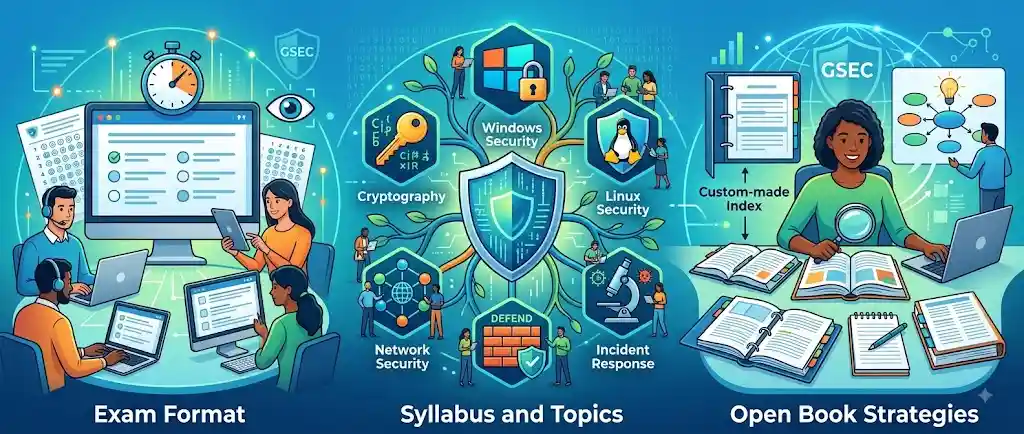
The GSEC Certification (GIAC Security Essentials) is an elite, DoD 8140-approved credential that validates hands-on IT security skills beyond basic theory. Administered by GIAC, the exam tests practical knowledge across active defense, cryptography, and network architecture. It features 106 questions, a 4-hour time limit, and hands-on CyberLive virtual machine tasks. Candidates must achieve a 73% passing score. The exam is strictly open-book, requiring a highly organized custom index for success.
Moving Beyond Entry-Level Theory
Unlike entry-level security certifications that rely heavily on multiple-choice vocabulary tests, the GSEC Certification demands functional, operational knowledge. Employers look to GSEC credential holders to configure firewalls, implement robust cryptography, harden Windows and Linux environments, and analyze network traffic in real-time.
If you are transitioning from a systems administration role or looking to elevate a junior SOC analyst position, this credential proves you can execute security protocols on live systems.
GIAC Security Essentials Eligibility Requirements
GIAC does not mandate strict prerequisites for attempting their exams, meaning anyone can purchase an exam voucher. However, the unofficial GIAC Security Essentials eligibility requirements dictate that candidates should possess a strong foundational understanding of IT systems before attempting the material.
To avoid failing, candidates should have:
-
12 to 18 months of IT experience (specifically in networking or systems administration).
-
Familiarity with TCP/IP protocols, subnetting, and basic packet analysis.
-
Working knowledge of Windows Active Directory and Linux command-line interfaces.
GSEC Syllabus and Domain Breakdown
The GSEC covers an immense amount of technical real estate. Understanding the GSEC syllabus and domain breakdown is critical, as you will need to categorize these topics efficiently to navigate your reference materials during the exam.
| Knowledge Domain | Core Concepts Tested | Practical Application |
| Defensible Network Architecture | Virtualization, Cloud Security, Honeypots, Firewalls, NIDS/NIPS | Configuring rule sets and monitoring ingress/egress traffic. |
| Endpoint Security & Hardening | Windows Access Controls, PowerShell, Linux Permissions, OS Hardening | Implementing Group Policy Objects (GPOs) and executing secure bash scripts. |
| Cryptography & Authentication | PKI, Steganography, Hash Functions, Password Cracking, MFA | Managing certificate lifecycles and mitigating credential-stuffing attacks. |
| Active Defense & Incident Handling | Threat Hunting, Malware Analysis, Incident Response Cycle (PICERL) | Analyzing memory dumps and containing active network breaches. |
| Web Communication Security | DNS, HTTP/HTTPS, Web Application Vulnerabilities (OWASP) | Identifying cross-site scripting (XSS) or SQL injection in raw web traffic. |
SANS SEC401 Course Alignment
GIAC exams are tightly coupled with SANS Institute training. The SANS SEC401 course alignment is the foundation of the GSEC exam. SEC401: Security Essentials: Network, Endpoint, and Cloud provides the exact curriculum, labs, and textbooks that the GSEC tests against.
While you are not required to take the SANS SEC401 course to sit for the GIAC exam (you can challenge the exam directly), the exam questions are written specifically referencing the SEC401 courseware. If you are challenging the exam without the SANS books, you must meticulously build your knowledge base from external industry documentation, such as the NIST Cybersecurity Framework.
GSEC Exam Format and Open Book Strategy
The GSEC is a grueling, marathon-style test. The GSEC exam format and open book strategy dictate that you cannot rely on memory alone. The exam consists of 106 questions completed over 4 hours, averaging just over two minutes per question.
Crucially, the exam includes CyberLive questions. These are not multiple-choice scenarios; you will be dropped into a live Virtual Machine (Linux or Windows) and asked to perform a specific task—like extracting a file hash, parsing a PCAP file, or modifying user permissions—to find the correct answer.
Because GIAC exams are open-book, candidates frequently make the fatal mistake of assuming the test will be easy. Open book does not mean open internet. You can bring physical textbooks, printed notes, and indices, but you cannot bring electronics. If you spend five minutes flipping through pages to find a single definition, you will fail on time.
How to Create a GSEC Open Book Index
Your physical index is your most critical tool. If you want to know how to create a GSEC open book index, follow this strict protocol:
-
Alphabetize Granularly: Do not index by chapter. Create a master spreadsheet (A-Z) of every tool, concept, port number, and protocol mentioned in your study materials.
-
Map to Book and Page: Format your index columns as:
Term | Definition/Context | Book Number | Page Number. (e.g., Nmap | SYN Stealth Scan | Book 3 | Pg 42). -
Color-Code Your Tabs: Assign a specific color to each book (e.g., Book 1 is Red, Book 2 is Blue). Tab the physical books accordingly.
-
Create a Quick-Reference Cheat Sheet: Print a one-page cheat sheet containing critical port numbers, Linux/Windows command-line syntax, and the OSI model for instant recall during CyberLive VM tasks.
How to Pass the GSEC Exam on First Attempt
Understanding the theory is only half the battle. Learning how to pass the GSEC exam on first attempt requires simulating the actual testing environment.
Do not waste your GIAC practice tests early in your study cycle. Use them two weeks before your actual exam date to stress-test your printed index. If you find yourself unable to locate an answer in your index within 45 seconds, your index is flawed and needs revision.
To supplement your preparation, drill extensively with high-quality GSEC practice exam questions. Exposing yourself to varied question phrasing and realistic CyberLive lab scenarios builds the muscle memory required to navigate the four-hour testing window without fatigue. You can access verified, comprehensive practice labs and question dumps at PassYourCert GSEC Prep.
Immediate Next Steps
If you are challenging the GSEC, map out a 10-week study plan today. Dedicate your first six weeks to mastering the syllabus domains and building your master index spreadsheet, leaving the final month exclusively for hands-on Linux/Windows VM labs and timed practice exams.